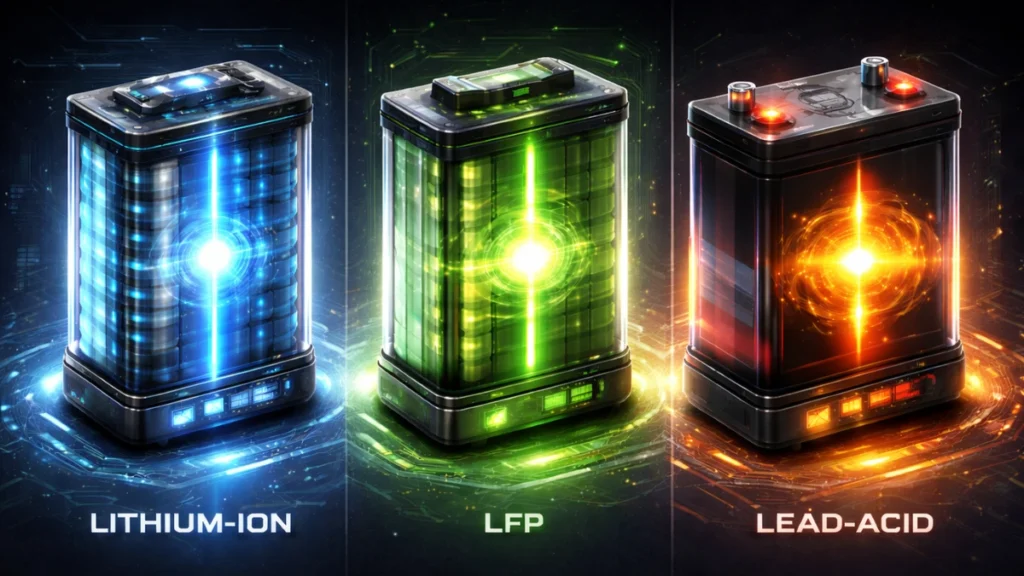
Electric scooters and motorcycles are evolving fast, but one question still confuses many riders: what batteries are actually used today?
If you’ve been researching electric two-wheelers, you’ve probably come across battery types like lithium-ion, LFP, or even lead-acid. The reality in 2026 is that the market uses a mix of battery technologies, each designed for different needs—performance, cost, safety, and lifespan.
Here’s a clear breakdown of the most commonly used batteries in 2026, how they differ, and which one is best for your riding style.
1. Lithium-Ion Batteries (NMC/NCA)
The Performance Leader
Lithium-ion batteries—especially NMC (Nickel Manganese Cobalt) and NCA (Nickel Cobalt Aluminum)—remain the top choice for high-performance electric motorcycles and premium scooters.
Learn more about NMC vs NCA Batteries: What’s the Real Difference?
These batteries are widely used because they offer high energy density, meaning they can store more energy in a smaller, lighter package. This directly translates to longer range and better acceleration.
Why they’re still dominant:
- High energy density → longer riding range
- Lightweight → better handling and acceleration
- Fast charging capability
- Strong performance at higher speeds
Where you’ll find them:
- Electric sport motorcycles
- Premium urban scooters
- Long-range commuter EVs
Downsides:
- More expensive than other battery types
- Sensitive to heat → requires a good battery management system (BMS)
- Degrades faster if frequently fast-charged
2. LFP (Lithium Iron Phosphate)
The New Mainstream Standard
In 2026, LFP batteries have become the most widely used battery type in electric scooters and many commuter motorcycles.
While they don’t match lithium-ion (NMC) in raw energy density, they offer something even more valuable for everyday users: durability, safety, and lower cost.
Why LFP is taking over:
- Much longer lifespan (often 2–3× more charge cycles than NMC)
- Excellent thermal stability (safer in hot climates)
- Lower cost (no cobalt or nickel)
- Can be charged to 100% regularly without major degradation
Ideal for:
- Daily commuting
- Delivery and fleet vehicles
- Urban electric scooters
- Riders who charge overnight
Trade-offs:
- Slightly shorter range compared to NMC
- Heavier for the same capacity
3. Lead-Acid Batteries
The Budget Models
Despite being outdated, lead-acid batteries are still used in entry-level electric scooters, particularly in price-sensitive markets.
They’re simple, cheap, and widely available—but come with major compromises.
Why they still exist:
- Very low upfront cost
- Easy to manufacture and recycle
- Simple technology
Limitations:
- Heavy → reduces efficiency and handling
- Short lifespan (often 300–500 cycles)
- Limited range
- Slow charging
Typical use cases:
- Low-speed electric scooters
- Ultra-budget models
- Short-distance commuting
4. Emerging Batteries (Solid-State & Sodium-Ion)
The Future (Not Mainstream Yet)
You may have heard about solid-state or sodium-ion batteries, often described as the future of EVs.
While promising, these technologies are not yet widely used in production electric scooters or motorcycles in 2026.
What’s being developed:
Solid-state batteries
- Higher energy density
- Faster charging potential
- Improved safety
Sodium-ion batteries
- Lower cost alternative to lithium
- Better availability of raw materials
Reality in 2026:
- Limited commercial availability
- Mostly in testing or early deployment
- Not common in real-world two-wheel EVs
Quick Comparison: What’s Actually Used Today?
| Battery Type | Usage in 2026 | Range | Lifespan | Cost | Best For |
|---|---|---|---|---|---|
| Lithium-ion (NMC/NCA) | High (premium) | High | Medium | High | Performance bikes |
| LFP | Very High (mainstream) | Medium | High | Medium | Daily scooters |
| Lead-acid | Declining (budget) | Low | Low | Low | Cheap scooters |
| Solid-state | Rare | Very High | Unknown | Very High | Future tech |
Which Battery Type Is Most Common in 2026?
LFP (Lithium Iron Phosphate) batteries are now the most widely used in electric scooters and commuter motorcycles.
This shift is driven by:
- Lower cost
- Longer lifespan
- Better safety in real-world conditions
However:
- Lithium-ion (NMC/NCA) still dominates performance-focused models
- Lead-acid remains in ultra-budget segments
How to Choose the Right Battery for Your Electric Scooter or Motorcycle
Choosing the right battery type depends on how you actually use your vehicle.
Choose LFP if you:
- Ride daily in the city
- Want a long battery lifespan
- Prefer safer, low-maintenance tech
- Charge frequently (even to 100%)
Choose Lithium-ion (NMC/NCA) if you:
- Need maximum range
- Want stronger acceleration
- Ride at higher speeds or longer distances
Consider Lead-Acid only if you:
- Have a very tight budget
- Use the scooter for short trips only
Final Thoughts
Battery technology is one of the most important factors in any electric scooter or motorcycle—and in 2026, the market is becoming clearer:
- LFP is the new mainstream standard
- Lithium-ion (NMC/NCA) remains the performance leader
- Lead-acid is slowly fading out
Understanding these differences helps you make a smarter decision—not just based on specs, but on how the vehicle will perform in your daily life.
FAQ
LFP (Lithium Iron Phosphate) is the most widely used due to its safety, long lifespan, and affordability.
Yes, lithium-ion batteries—especially NMC and NCA—are still commonly used in high-performance electric motorcycles because of their higher energy density and longer range.
Mainly because they are cheap, even though they are heavier and have shorter lifespans.
LFP is a type of lithium battery, but it uses a different chemistry. It offers better safety and longer lifespan, while traditional lithium-ion (NMC/NCA) provides higher energy density and better performance.
LFP batteries typically last the longest, often reaching 3,000–5,000 charge cycles, which is significantly higher than most lithium-ion (NMC) batteries.
LFP batteries are considered the safest due to their high thermal stability and lower risk of overheating or catching fire.
LFP batteries are generally the best choice for daily commuting due to their durability, safety, and ability to handle frequent charging.