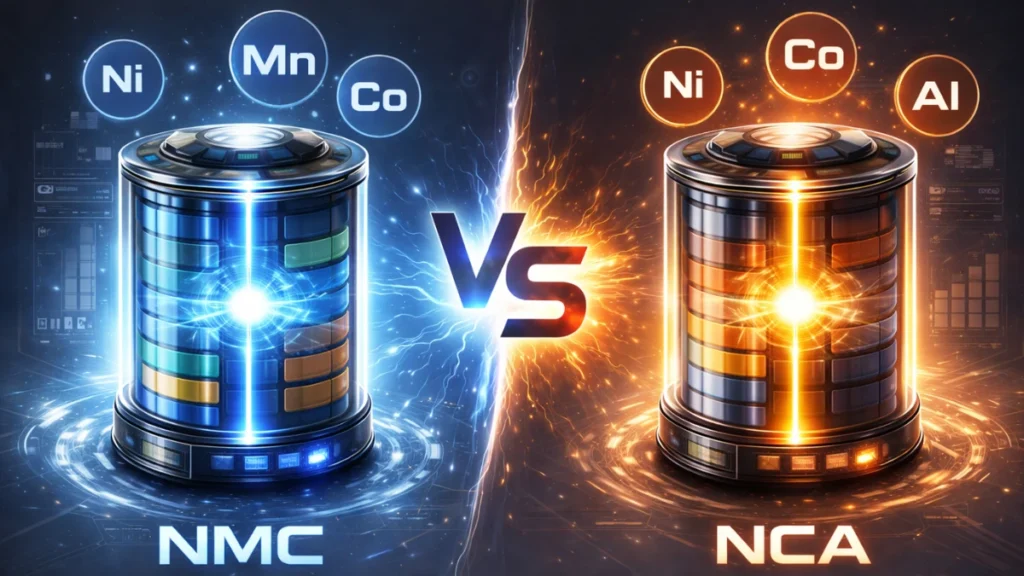
If you’re researching electric scooters or motorcycles, you’ve probably seen battery specs like NMC or NCA—but what do they actually mean for your daily ride?
The real difference isn’t about “which is better,” but which trade-off you’re willing to accept:
NMC = balanced, safer, longer-lasting
NCA = higher range, lighter, more performance-focused
Find out EV Scooter & Motorcycle Batteries: What’s Actually Used in 2026?
Let’s break it down clearly.
Table of Contents
What Is an NMC Battery?
NMC (Nickel Manganese Cobalt) is the most widely used lithium-ion chemistry in electric scooters and motorcycles.
It combines:
- Nickel → higher energy capacity
- Manganese → safety and stability
- Cobalt → performance and lifespan
The key advantage: balance
Manufacturers can tune NMC depending on the bike:
- More nickel → longer range
- More manganese → safer, cooler operation
What Is an NCA Battery?
NCA (Nickel Cobalt Aluminum) is designed for one main goal:
Maximum energy density (more range in a smaller, lighter battery)
Compared to NMC:
- No manganese (less inherent stability)
- Includes aluminum (improves energy performance)
Result: lighter battery packs with higher range—but more demanding thermal management.
Why This Matters for Electric Scooters & Motorcycles
Unlike cars, two-wheelers have:
- Limited battery space
- Lower cooling capability
- Strong sensitivity to weight
So the battery chemistry directly impacts:
- Range per charge
- Heat management
- Long-term durability
- Price of the vehicle
Key Differences
1. Range per Charge
- NMC: Good range (typical scooters: 60–120 km)
- NCA: Higher range potential in the same size pack
NCA can squeeze out extra kilometers, especially in premium models.
2. Safety & Heat Management
- NMC: More stable, handles heat better
- NCA: Runs hotter, needs a better battery management system (BMS)
In stop-and-go city riding (common for scooters), thermal stability matters.
3. Battery Lifespan
- NMC: Longer cycle life (better for daily charging)
- NCA: Slightly faster degradation over time
If you charge frequently (typical urban usage), NMC holds up better.
4. Weight & Efficiency
- NMC: Slightly heavier
- NCA: Lighter for the same capacity
This affects:
- Acceleration
- Handling
- Energy efficiency
5. Cost
- NMC: More affordable and widely available
- NCA: More expensive, used in premium setups
This is why most budget and mid-range scooters use NMC.
Simple Use Case Comparison
Choose NMC if you:
- Ride daily in the city
- Want a reliable, long-lasting battery
- Prefer lower maintenance and cost
- Use your scooter for commuting or delivery
Best for: 90% of riders
Choose NCA if you:
- Want maximum range in a compact battery
- Care about performance and acceleration
- Buying a premium electric motorcycle
Best for: enthusiasts or high-performance use
Real Insight: What Actually Matters
For electric two-wheelers, battery chemistry is just one piece.
More important factors:
- Battery management system (BMS) quality
- Cooling design (air vs passive)
- Riding style (speed, load, terrain)
A well-designed NMC battery can outperform a poorly managed NCA pack.
Conclusion
At the end, choosing between NMC and NCA isn’t just about specs—it’s about how you actually use your bike.
For the two-wheeler market in 2026:
NMC dominates because it’s practical, durable, and cost-efficient.
NCA exists for niche, high-performance use cases
If you’re choosing an electric scooter or motorcycle today:
NMC is the safest and smartest default choice
NCA is a premium upgrade for range and performance
FAQ
It depends on your use:
– NMC → better for daily use (safer, longer lifespan, more affordable)
– NCA → better for performance (higher range, lighter weight)
For most riders: NMC is the better overall choice
NMC
– Lower production cost
– More widely available
Better for budget and mid-range bikes.
Yes—but with conditions:
– Requires good thermal management
– More sensitive to heat compared to NMC
Unlikely (for two-wheelers) Trend in 2026:
– NMC continues to dominate
– LFP is growing fast
– NCA remains niche
Each chemistry serves a different purpose—there’s no one-size-fits-all winner.
Not much
Charging speed depends more on:
– Charger power
– Battery Management System (BMS)
The difference between NMC and NCA is not much.