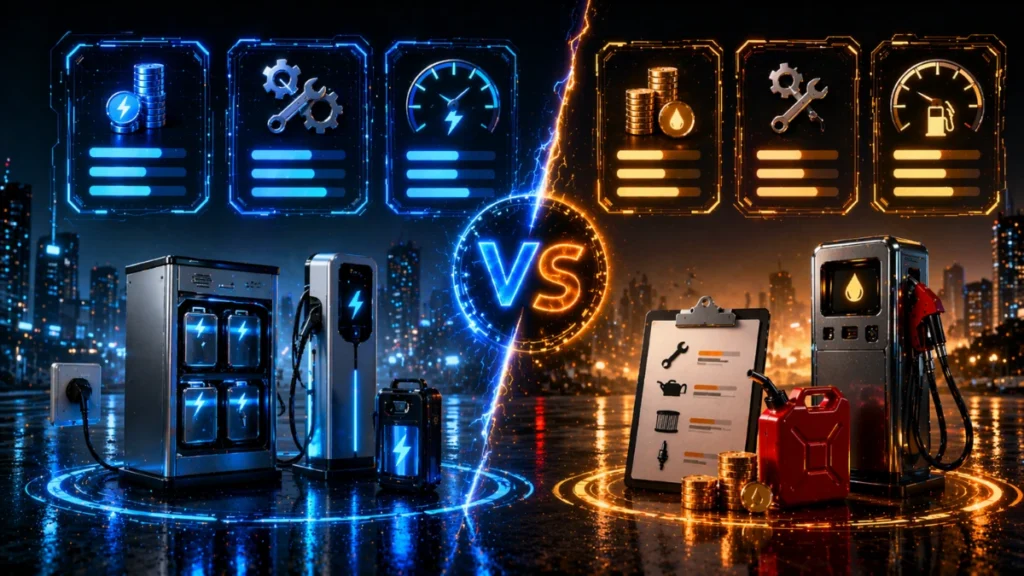
The transition from gasoline-powered vehicles to electric vehicles (EVs) is accelerating worldwide—especially in the two-wheeler segment. But beyond environmental benefits, the real question for most riders is practical:
Are EVs actually better than gasoline vehicles in terms of cost, maintenance, and performance?
So how do they really compare? Let’s break it down with real-world data.
Table of Contents
1. Total Cost of Ownership: EV vs Gasoline
When comparing EVs and gasoline vehicles, the most important metric isn’t just the purchase price—it’s the total cost of ownership (TCO).
Upfront Cost
- EVs: Typically higher initial price due to battery costs
- Gasoline vehicles: Lower purchase price, especially in entry-level segments
However, this gap is narrowing as battery prices decrease and more affordable EV models enter the market.
Fuel / Energy Cost
- EVs: Powered by electricity, which is significantly cheaper per kilometer
- Gasoline vehicles: Dependent on fluctuating fuel prices
In many regions, EV charging can cost less than half of gasoline per distance traveled, especially when charging at home.
Key insight:
- EV = low running cost
- Gasoline = high ongoing fuel expense
Long-Term Cost
Despite higher upfront prices, EVs often become cheaper over time due to:
- Lower energy costs
- Reduced maintenance
- Fewer mechanical failures
2. Maintenance: Simplicity vs Complexity
Maintenance is where EVs clearly outperform gasoline vehicles.
Why EVs Are Cheaper to Maintain
Electric vehicles have:
- Fewer moving parts
- No engine oil
- No exhaust system
- No transmission complexity
As a result, EV maintenance costs are typically 30–50% lower than gasoline vehicles.
Typical Maintenance Comparison
| Component | EV | Gasoline |
|---|---|---|
| Oil change | ❌ Not required | ✅ Regular |
| Transmission | ❌ Minimal | ✅ Complex |
| Brake wear | 🔽 Lower (regen braking) | 🔼 Higher |
| Engine parts | ❌ None | ✅ Many |
The Trade-Off
EV downside:
- Battery replacement can be expensive (though rare and often covered by warranty)
- Repairs may cost more when they do occur
3. Performance: Instant Torque vs Traditional Power
Performance is where EVs deliver a completely different riding experience.
Electric motorcycles offer instant torque and smooth acceleration, creating a very different riding experience compared to gasoline vehicles. For a closer look at the real-world advantages and limitations, check our guide on Electric Motorcycles: the Good, the Bad, and the Reality
Acceleration & Power Delivery
EVs:
- Instant torque (0 RPM)
- Smooth and linear acceleration
- No gear shifting
Gasoline vehicles:
- Power builds gradually
- Requires gear changes
- More vibration and noise
Top Speed & Range
Gasoline vehicles:
- Higher top speed (in most cases)
- Longer range
- Faster refueling
EVs:
- Limited range (improving rapidly)
- Charging takes longer than refueling
Riding Experience
EV advantages:
- Quiet operation
- Smooth ride
- Less vibration
- Lower heat generation
Gasoline advantages:
- Familiar feel for traditional riders
- Better for long-distance touring
4. Reliability and Durability
EVs benefit from mechanical simplicity:
- Fewer components = fewer failure points
- Electric motors are highly durable
Gasoline vehicles:
- More complex systems
- Higher wear and tear over time
Modern EVs can last as long as gasoline vehicles, with batteries often designed for long lifespans.
5. Battery Swapping: A Growing EV Advantage
One of the biggest concerns for electric two-wheelers has always been charging time. However, this is rapidly changing with the rise of battery swapping stations.
What is Battery Swapping?
Instead of waiting to charge, riders can:
- Visit a swap station
- Exchange their depleted battery
- Get a fully charged battery in minutes
This makes EV refueling almost as fast as gasoline.
Rapid Growth of Swap Infrastructure
Battery swapping is no longer experimental—it’s expanding quickly, especially in Southeast Asia.
- In Indonesia alone, networks like SWAP Energy have deployed over 1,500 battery swapping stations nationwide
- Major players such as Pertamina have also launched public swap stations to support EV adoption
- The system is becoming a key solution to overcome charging limitations and range anxiety
Battery swap stations are starting to become as common as charging points in urban areas.
The Trade-Off
Despite its growth, there are still challenges:
- Lack of battery standardization across brands
- Availability may vary by city
- Station capacity and battery quality can differ
However, as infrastructure expands, these issues are gradually improving.
With the rapid expansion of battery swapping networks, EV two-wheelers are no longer limited by charging time.
Combined with lower operating costs and minimal maintenance, EVs are now closing the final gap with gasoline vehicles—even in convenience.
Conclusion
EVs dominate in:
- Cost efficiency (long-term)
- Maintenance simplicity
- Urban performance
Gasoline vehicles still win in:
- Range and refueling convenience
- Initial purchase affordability
- Long-distance flexibility
For most daily riders especially in cities, electric two-wheelers are already the more practical and economical choice.
FAQ
EVs are better for city use because they are quieter, smoother, and more cost-efficient for short distances.
Yes. Most electric two-wheelers offer 60 – 100 km range, which is sufficient for daily commuting.
Yes, electric two-wheelers are generally cheaper in the long run due to lower energy and maintenance costs, even if the upfront price is higher.
Yes. EVs have fewer moving parts, no oil changes, and simpler drivetrains, making maintenance significantly lower.
Charging usually takes 4–8 hours, depending on battery size and charger type.
Yes, battery replacement can be costly, but it’s rare in the early years and usually covered by warranties.