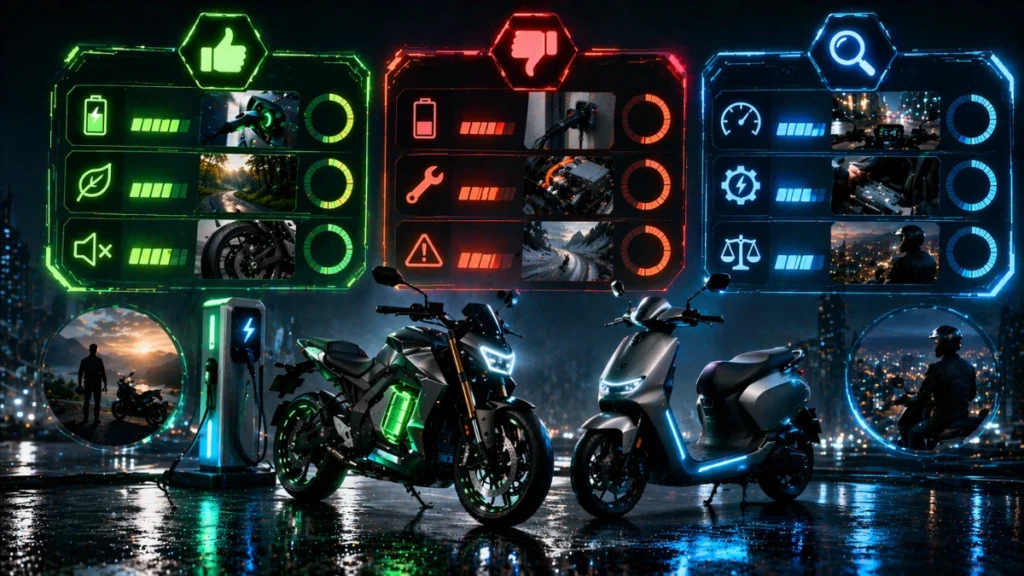
Electric motorcycles are no longer a futuristic concept—they’re rapidly becoming a practical alternative to traditional gasoline-powered bikes. With rising fuel costs, stricter emissions regulations, and advances in battery technology, more riders are considering switching to electric.
But beyond the hype, what’s the real story?
If you’re considering switching from a gasoline bike, check our EV vs Gasoline: Cost, Maintenance, and Performance Comparison for a deeper look.
Table of Contents
The Good: Why Riders Are Switching to Electric
1. Lower Operating Costs
One of the biggest advantages is cost savings over time.
- Electricity is significantly cheaper than gasoline
- Charging at home reduces dependency on fuel stations
- The cost per kilometer is much lower
For daily riders, especially commuters, the long-term savings can be substantial.
2. Minimal Maintenance
Forget routine engine maintenance.
Electric motorcycles don’t require:
- Oil changes
- Spark plug replacements
- Complex engine servicing
This results in lower maintenance costs.
3. Smooth and Instant Performance
Electric motors deliver power instantly.
That means:
- Quick acceleration from a stop
- Smooth, linear power delivery
- No gear shifting (on most models)
This makes electric motorcycles especially ideal for urban riding.
4. Zero Emissions
Electric motorcycles produce no tailpipe emissions.
- Reduce air pollution in cities
- Lower carbon footprint (especially if powered by renewable energy)
- Support global sustainability goals
If you care about cleaner cities, this is a major advantage.
5. Charging Is Getting Easier
Charging infrastructure is improving fast.
Today, you can:
- Charge at home overnight
- Use public charging stations
- Swap batteries in seconds (in supported regions)
Battery swapping is becoming increasingly popular in Southeast Asia, making charging even faster and more practical.
The Bad: Where EVs Still Falls Short
1. Limited Range
Range remains one of the biggest trade-offs.
- Most electric motorcycles can’t match gasoline range
- Real-world range depends on speed, terrain, and riding style
For long-distance travel, this can be restrictive.
2. Charging Takes Time
Charging takes longer than refueling:
- Standard charging can take hours
- Fast charging is not always available
- Swap stations are still limited by network coverage
This requires more planning, especially for longer trips.
3. Higher Upfront Cost
Electric motorcycles often cost more initially due to:
- Expensive battery technology
- Production scale is still growing
However, the higher upfront cost can be offset by long-term savings.
4. Charging Infrastructure Limitations
While improving, infrastructure gaps still exist:
- Limited charging stations in some regions
- Uneven access to fast charging
- Battery swap networks are not universally available
Your location plays a big role in how practical an EV is.
5. Battery Degradation Over Time
Like all batteries, EV batteries age.
- Performance decreases over time
- Replacement costs can be high
- Resale value may be affected
This is a long-term factor many buyers overlook.
The Reality: Who Electric Motorcycles Are Actually For
Electric motorcycles are not for everyone—at least not yet.
They make the most sense if you are:
Daily Commuters
Short to medium distances with predictable routes
Urban Riders
Stop-and-go traffic benefits from instant torque and smooth control.
Cost-Focused
Looking to reduce fuel and maintenance expenses
Environmentally aware riders
If reducing emissions matters to you, electric is the obvious choice.
Conclusion
Electric motorcycles offer clear advantages in cost efficiency, maintenance, and environmental impact. However, limitations in range, charging time, and infrastructure still make them less suitable for some use cases.
Electric motorcycles aren’t just “better” or “worse”—they’re different.
The transition to electric is happening. And whether they’re right for you depends entirely on where you ride, how you ride, and what you prioritize.
FAQ
Yes, electric motorcycles are worth it for daily commuting and urban riding. They offer lower running costs, minimal maintenance, and a smoother riding experience. However, they may not be ideal for long-distance travel due to range limitations.
Range varies by model, but most electric motorcycles offer 60 to 150 km per charge. High-end models can exceed this, while the real-world range depends on speed, terrain, and riding style.
Charging time depends on the charger type:
– Standard charging: 4–8 hours
– Fast charging: 1–2 hours
– Battery swap: a few minutes (if available)
Yes, in terms of operating costs. Electricity is cheaper than fuel, and maintenance costs are significantly lower. However, upfront prices are usually higher.
Yes, but much less than gasoline motorcycles. There’s no need for oil changes or engine maintenance, but components like brakes, tires, and batteries still require attention.
Yes. Most electric motorcycles are designed to be water-resistant and safe to ride in the rain. However, submerging the bike in deep water should be avoided.
It depends on your region. Urban areas are improving quickly, but rural areas may still have limited charging options. Battery swap networks are expanding in some countries.
Most electric motorcycles are gearless, meaning no manual shifting is required. This makes them easier to ride, especially for beginners.
The main drawbacks include:
– Limited range
– Charging time
– Higher upfront cost
– Limited infrastructure in some areas